บ้าน / ข่าว / ข่าวอุตสาหกรรม / How to Match Men's Dress Socks: Colors, Lengths, Patterns, and Materials
How to Match Men's Dress Socks: Colors, Lengths, Patterns, and Materials
You sit down in a meeting, cross your legs, and a band of bare skin appears between the trouser hem and the top of the shoe. The suit is fine, the shirt is fine, and the shoes are polished. The socks have already decided how the whole outfit reads.
The short answer on how to match men's dress socks is this: match the trouser, not the shoe. Stay inside the trouser color family, go one or two shades darker, keep the sock long enough to stay covered when you sit, and keep the pattern quieter as the occasion becomes more formal. The shoe only sets the leather tone and the texture.
The rest of this guide explains why those rules hold, when it is safe to break them, and what to check before ordering a dozen pairs at once.
Match the Trouser First, Then the Shoe
A suit reads as one continuous vertical shape from shoulder to shoe. When the sock color sits close to the trouser color, that shape is not interrupted at the ankle. When the sock matches the shoe instead, the ankle becomes a hard horizontal line and the leg looks shorter. This is why a navy sock under navy wool almost disappears, while a black sock under light grey wool looks like an accident.
There is one practical exception. When the trousers are much lighter than the shoes, matching the trouser can look washed out. Stone chinos with dark brown loafers are easier to solve with mid grey, olive, or navy than with a pale sock that copies the chinos.
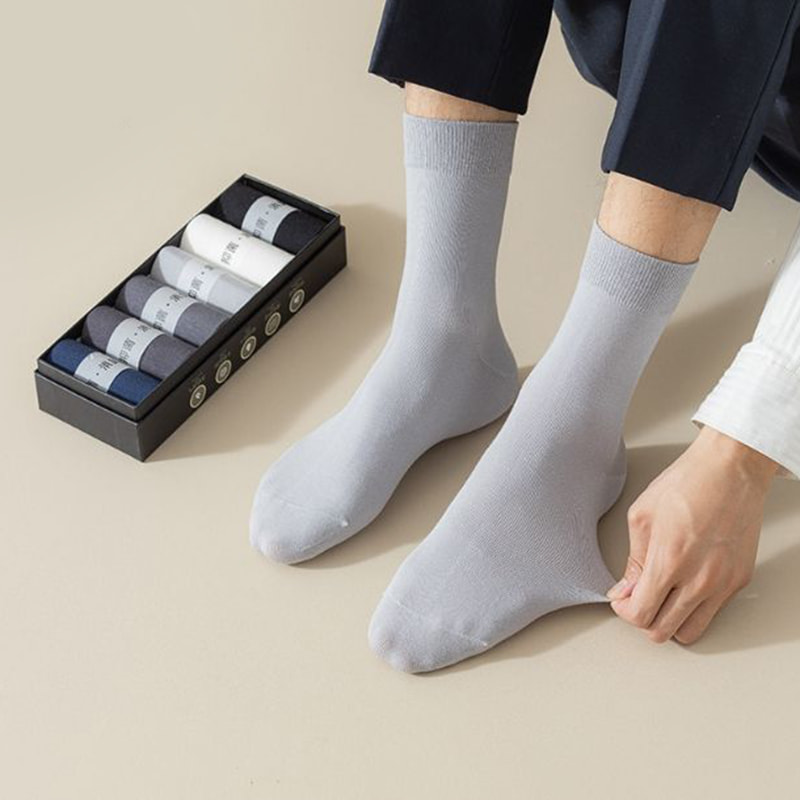
A pre-packed set removes most of the guesswork on formal days, because the tones inside the box are already built to work with navy, charcoal, and black tailoring.
Two checks before you buy. Hold the sock against the trouser leg rather than against the shoe, and look at both under the light you actually dress in, because an office lamp and a window change how close two dark tones appear.
Sock Length Decides Whether the Match Survives
Color is the part men think about. Length is the part that gives them away. A trouser hem rises two to four centimeters when you sit and cross your legs, and a sock that ends below that line exposes skin no matter how accurate the color match is.
Over-the-calf: the safe choice for suits and formal events, because it stays covered in every seated posture.
Mid-calf: the practical minimum for business casual and the most common dress sock height.
Ankle and quarter: casual only, usually with chinos or denim.
No-show: for bare ankle looks with loafers and shorts, never with a suit.
For a working wardrobe, keep two or three core colors in mid-length dress socks and one or two over-the-calf pairs for formal days. That small, predictable set covers almost every weekday.
The line chart tracks a bare-skin exposure risk index from 0 to 100 as sock length increases, measured across three everyday postures. While standing still, a no-show sock already carries a high risk, because the shoe opening and the trouser hem rarely meet perfectly. The risk reaches 100 when you sit and cross your legs in a no-show or ankle sock, which is exactly the moment a short sock becomes visible to everyone at the table. Walking splits the difference, since the moving hem exposes the ankle in short intervals rather than continuously. Mid-calf socks cut the seated risk to roughly a third, which is why they are the practical minimum for business casual. Over-the-calf socks push the line flat to zero in all three postures, because the fabric stays above the point where the hem rides up. In practice, the chart says one thing clearly: buy the length that survives the seated test, not the one that looks fine while you stand in front of a mirror.
Color Matching by Trouser and Shoe
Once length is settled, color becomes a short checklist. Work from the trouser, then check the shoe, then check the light in the room where the outfit will be worn.
A quick reference for sock color selection by trouser color, with the strongest match listed first.
Trouser color
First choice
Also works
Better avoided
Navy wool
Navy, one shade darker
Charcoal, mid grey
White, bright red
Charcoal
Charcoal
Navy, black
Cream, pale yellow
Mid grey
Mid grey or charcoal
Burgundy, navy
Neon tones
Black
Black
Charcoal
White, pastel blue
Brown or tan
Dark brown or navy
Olive, burgundy
Cool light grey
Stone or khaki
Mid grey or olive
Navy, brown
White for formal wear
Each bar is an editorial score out of 100 for how safely a sock color sits under navy trousers in a business setting, not a survey result. Navy scores highest because it belongs to the same family as the trouser and runs only a shade darker, which is the classic tonal match. Charcoal and mid grey follow closely, since they sit in the same cool neutral group and never fight the blue. Burgundy and olive stay acceptable but turn the ankle into a deliberate accent, so they work better in smart casual than in a formal meeting. Black scores lower than most men expect, because against navy it reads as a different palette rather than a continuation of it. White fails almost every formal test under navy trousers, which is why it belongs with athletic shoes and denim. If you remember one line from this chart, remember the top three bars and build the core of the drawer there.
Patterns, Contrast, and Occasion
Pattern scale is the rule that keeps patterned socks wearable. The sock pattern should be smaller than the pattern on the suit, and it should repeat a color that already exists somewhere in the outfit. A fine herringbone or birdseye sock in the trouser tone adds texture without pulling the eye downward.
Business formal
Solid dark socks, no visible logo, matte finish, and a length that covers the calf when seated. If the tie and the pocket square are already competing for attention, the socks should stay quiet and close to the trouser tone.
Weddings and evening events
Dark solid socks carry the ceremony and the photographs. A colored or patterned pair saved for the reception is a reasonable second pair, provided the trousers stay plain and the shoes are dark leather.
Weekend and smart casual
This is where contrast is allowed to work: olive socks with stone chinos, burgundy with grey flannel, or a small dot pattern with a plain shirt. Keep the trousers solid when the socks are loud, and keep the socks solid when the trousers are patterned.
Build a Rotation That Covers the Week
Fourteen pairs cover two working weeks, which gives one laundry cycle of buffer and enough rest time for the elastic to recover between wears. The column chart splits that number by color so the drawer covers formal days first and accent days second.
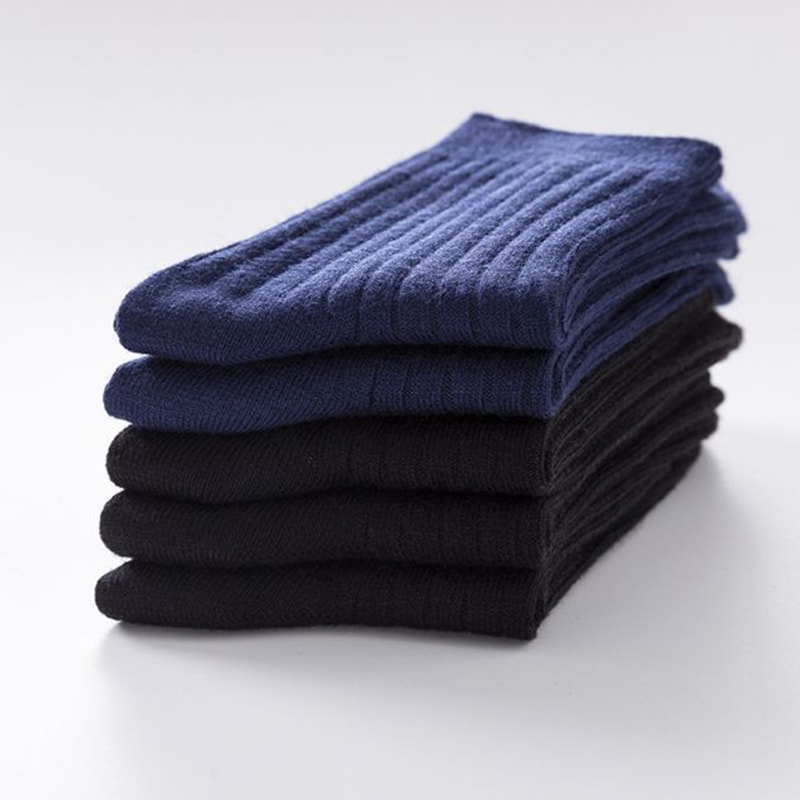
The column chart is a drawer plan rather than a style rule: it shows a fourteen-pair rotation that covers two working weeks of daily wear. Navy takes the largest block at four pairs, because it is the safest match for both navy and charcoal trousers and hides the wear of a long week. Charcoal gets three pairs and black gets two, which together cover most formal days without leaving a gap on laundry day. Mid grey adds two more pairs for lighter suits and for days when you want a softer transition between grey trousers and brown shoes. Burgundy, olive, and one patterned pair are deliberately limited to one each, since they are accent pieces that need a plain outfit around them. Fourteen pairs also matters for care, because each pair rests between wears and the elastic has time to recover. Use the columns as a shopping list for a first order, then adjust the accent columns upward once you know which pairs you actually reach for.
Material and Weave Matter as Much as Color
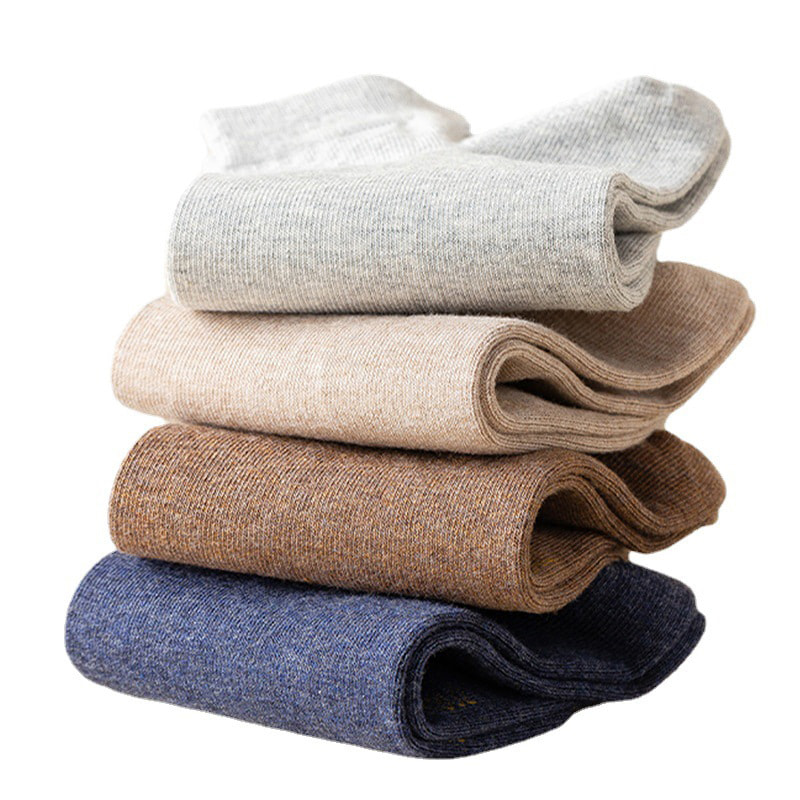
Fiber decides how a sock behaves after the fourth hour of wear. Merino wool regulates temperature and resists odor, which is why it dominates winter tailoring. Combed cotton feels cooler and holds a crisp shape through a warm office day. Synthetic blends last longer and keep their shape, but they trap moisture and look less refined under a suit.
Weave matters too. A fine rib or a flat knit stays smooth inside a leather shoe, while a heavy looped knit adds bulk that can change how a shoe fits. For a cold season order, a mid-length wool pair adds warmth without breaking the color rule.
The radar chart compares three common dress sock fibers across five dimensions: moisture control, durability, formality, warmth, and shape retention. Merino wool holds the largest footprint, which matches its reputation for temperature regulation through a long day. Combed cotton is close behind on durability and formality but lower on warmth and moisture control, so it suits spring, summer, and heated offices better than a cold commute. The synthetic blend wins on durability and shape retention, the two numbers that matter most for a sock washed twice a week, but it loses on formality and moisture control. The overlapping shapes also show where the fibers trade off, because a sock can be tough and slow to stretch out while still feeling less refined than wool or cotton. For most wardrobes the practical answer is a mixed drawer, with wool for winter and formal days, combed cotton for the middle of the year, and synthetics reserved for sport or hidden no-show pairs. Read the chart by axis rather than by total area, because the axis that matters depends on your climate and your week.
Care, Rotation, and Buying in Bulk
Two habits extend sock life more than anything else. Wash dark dress socks inside out in cold water, skip fabric softener, and air dry them instead of running a hot dryer cycle. Rotate at least five pairs so each one rests between wears, and check the cuff tension once a season, because a stretched cuff is what makes a pair slide down during a meeting.
If you wear low-cut cotton socks at the weekend, the same washing routine applies, and the sock care and maintenance notes cover the details in more depth.
When buying in bulk, keep color codes consistent across orders so replacements match the drawer you already own. It also helps to confirm three production details before the order runs: the knit structure, the yarn count, and the cuff tension. Those three decisions control whether a sock stays up through a working day and whether it still looks like the sample after twenty washes. Combed cotton solids in core colors are the safest base for that kind of repeat order, since they can be re-produced in the same tone season after season.
Matching men's dress socks comes down to three decisions made once: the color follows the trouser, the length survives a seated posture, and the fiber suits the season. Get those right and the socks stop being a detail anyone notices, which is exactly the point.
Start with two or three dark solids in mid-calf or over-the-calf, wear them for a month, then add pattern and accent colors based on what your wardrobe actually asks for.
American Tie Dye เป็นกระบวนการย้อมสีที่ไม่เหมือนใครซึ่งใช้เทคนิคการผูกและการย้อมสีที่เฉพาะเจาะจงเพื่อสร้างรูปแบบที่หลากหลายและมีสีสันและผลการไล่ระดับสีบนถุงเท้าเพิ่มความรู้สึกแฟชั่นและการปรับแต่งผลิตภัณฑ์ของผลิตภัณฑ์ ออกแบบด้วยความยาวกลางเหมาะสำหรับการสวมใส่กีฬาเช่นบาสเก็ตบอลให้การห่อที่เพียงพอและปกป้องข้อเท้าจากเคล็ดขัดยอกและการบาดเจ็บอื่น ๆ ด้านล่างได้รับการออกแบบด้วยผ้าขนหนูหนาซึ่งมีประสิทธิภาพการสั่นของความชื้นและสามารถดูดซับเหงื่อออกจากเท้าได้อย่างรวดเร็วทำให้แห้งและสะดวกสบายและลดการเลื่อนและแรงเสียดทานในระหว่างการออกกำลังกาย ร่างกายถุงเท้าอาจมีการออกแบบที่วนรอบเพื่อเพิ่มความหนาและความอบอุ่นของถุงเท้าในขณะที่ปรับปรุงความสะดวกสบายและความนุ่มนวลของการสวมใส่ ทำจากวัสดุฝ้ายบริสุทธิ์ฝ้ายบริสุทธิ์มีการระบายอากาศที่ดีและเป็นมิตรกับผิวหนังลดกลิ่นเท้าและการเจริญเติบโตของแบคทีเรียและรักษาสุขภาพเท้า ผลิตภัณฑ์อาจรวมองค์ประกอบสไตล์ Ins ยอดนิยมเช่นการจับคู่สีและการออกแบบรูปแบบเพื่อให้สอดคล้องกับความต้องการด้านสุนทรียภาพของผู้บริโภครุ่นเยาว์